#761 - What is wrong with this picture tricky
Can you find what's wrong with this park picture?

Look at the marked lady and look at her feet. She has two left feet.

Can you find what's wrong with this park picture?
Look at the marked lady and look at her feet. She has two left feet.
How was a full-sized apple placed inside a thin-necked glass bottle without breaking the bottle or cutting the fruit?
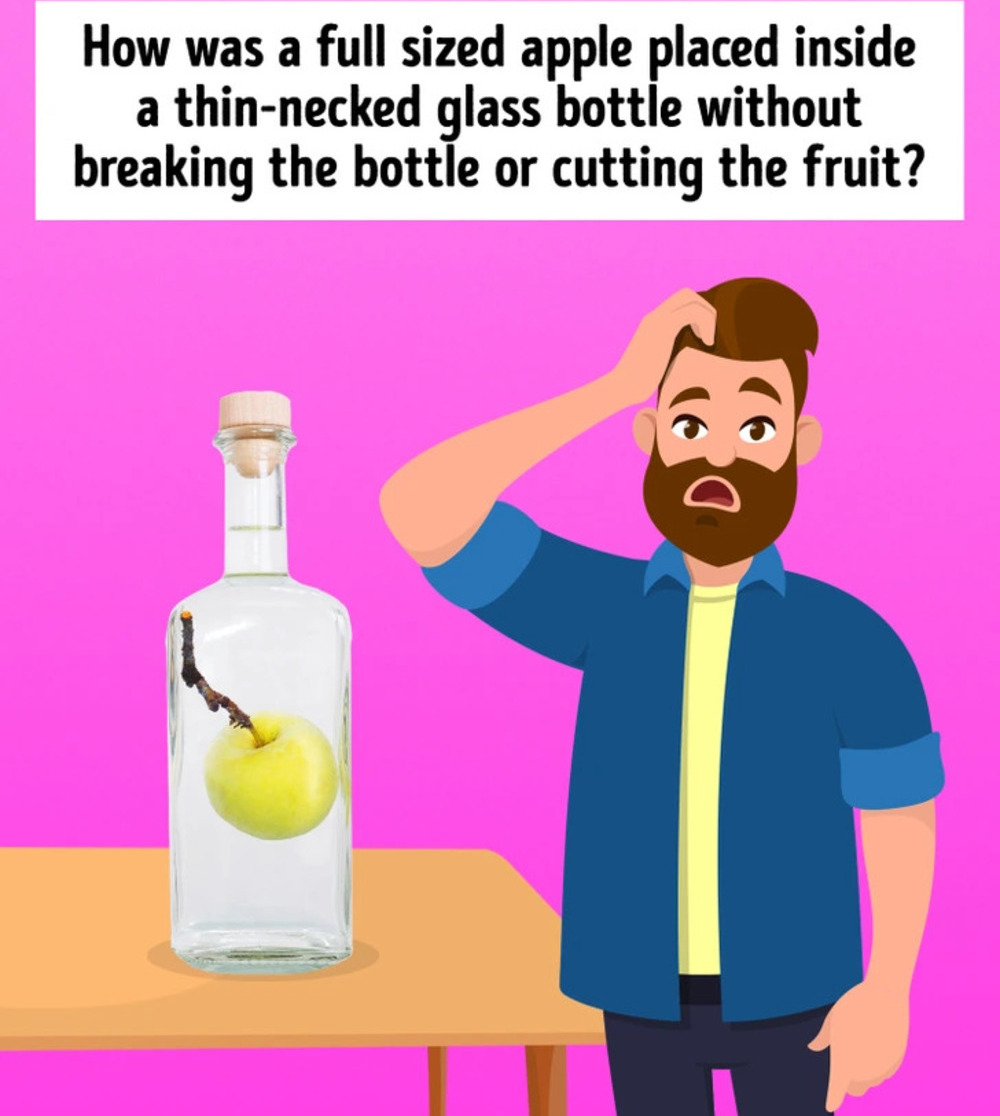
The apple grew inside the bottle. The bottle was placed on the tree branch before the apple was formed.
As the school year was progressing, a teacher was distressed that more and more of her students were beginning to tease and make fun of one another. She decided to do something about it. When they returned to the classroom after Spring Break, they saw a mirror on the wall with a sign next to it.
When one of the students came to her crying about the names she had been called at recess, she sent the girl to the mirror with these directions: Read that sign quietly to yourself. Repeat it over and over, gradually running the sounds together. Each time, look at yourself in the mirror. Soon you will be smiling.
Sure enough, when the student followed these directions, she came away smiling.
Each time a student would come to the teacher feeling low, she would give them the same directions. Sometimes they would have difficulty, so she would go over to read the sign with them. Eventually, each one would come away smiling.
This is what the sign said: I.Y.Q.Y.Q.R.
Why did this little exercise help her students feel better about themselves
When the students read the letters out loud, running them together, and looking in the mirror, they realized that they were telling themselves, 'I like you like you are!' It may not be perfect grammar, but the teacher reached her goal of building self-esteem in her students who had a low opinion of themselves because of teasing
The Puzzle: Here is a famous prize problem that Sam Loyd issued in 1882, offering $1000 as a prize for the best answer showing how to arrange the seven figures and the eight 'dots' .4.5.6.7.8.9.0. which would add up to 82
The dot over a number signifies that it is a repeater which would go on for ever, as when we endeavor to describe 1/3 decimally as 0.33333 . . . . (etc)
With a series of numbers we place the dot over the first and last, as with 0.97979797979 . . . (etc)
The remarkable feature being that a proper fraction divided by 9s e.g. 46/99 is exactly equal to the numerator with the repeater sign followed by the decimal.
Using the digits 1 up to 9, two numbers must be made. The product of these two numbers should be as large as possible. All digits must be used exactly once. Which are the requested two numbers. ?
The digits of the requested two numbers obviously form descending sequences. Furthermore, if you have two pairs of numbers with equal sums, the pair of which the numbers have the smallest absolute difference, is the one of which the numbers have the largest product. Using this knowledge, the two numbers can easily be constructed by placing the digits one by one, starting with 9 and ending with 1:
9
8 -> 96
87 -> 964
875 -> 9642
8753 -> 9642
87531
Conclusion: the requested two numbers are 9642 and 87531 (and the product of these two numbers is 843973902).
I am thinking of a 6-digit number. The sum of the digits is 43.
And only two of the following three statements about the number are true:
(1) it's a square number,
(2) it's a cube number, and
(3) the number is under 500000.
Only Statements 1 and 3 are true. the number is 499849.
7072 = 499849
499849<500000
Three people enter a room and have a green or blue hat placed on their head. They cannot see their own hat, but can see the other hats.
The color of each hat is purely random. They could all be green, or blue, or any combination of green and blue.
They need to guess their own hat color by writing it on a piece of paper, or they can write 'pass'.
They cannot communicate with each other in any way once the game starts. But they can have a strategy meeting before the game.
If at least one of them guesses correctly they win $50,000 each, but if anyone guess incorrectly they all get nothing.
What is the best strategy?
Simple strategy: Elect one person to be the guesser, the other two pass. The guesser chooses randomly 'green' or 'blue'. This gives them a 50% chance of winning.
Better strategy: If you see two blue or two green hats, then write down the opposite color, otherwise write down 'pass'.
It works like this ('-' means 'pass'):
Hats: GGG, Guess: BBB, Result: Lose
Hats: GGB, Guess: --B, Result: Win
Hats: GBG, Guess: -B-, Result: Win
Hats: GBB, Guess: G--, Result: Win
Hats: BGG, Guess: B--, Result: Win
Hats: BGB, Guess: -G-, Result: Win
Hats: BBG, Guess: --G, Result: Win
Hats: BBB, Guess: GGG, Result: Lose
Result: 75% chance of winning!
At a local village gala, the entire population turned up, 500 people. The event raised £3,000. Tickets were priced as follows:
£7.48 men
£7.12 women
£0.45 children.
How many men,women and children were there?
149 men , 259 women & 92 children